SAATI
Case study
Redesigning the website and establishing a design system for a leader in manufacturing innovative products
SAATI
Case study
Redesigning the website and establishing a design system for a leader in manufacturing innovative products
Overview
Project duration
9 months
Services
UX Strategy
UX Research
Buyer Journey Mapping Information Architecture Design Systems
Content Strategy
Testing
My role
Lead UX Designer for the SAATI website redesign, defining UX direction, buyer journeys, and the end-to-end website experience in collaboration with global stakeholders.
Brief
Redesigning a complex B2B platform to support lead generation
SAATI, a global B2B company serving industries such as electronics, textiles, and aerospace, needed to redesign its outdated website to better support lead generation. The existing platform struggled to clearly communicate complex, custom solutions and did not align well with the buyer journey.

Old homepage for SAATI
Challenges
Complexity at scale across products, teams, and markets
The project required aligning global teams while organising a large and complex product catalogue of over 2,500 items. Communicating highly technical and custom solutions in a clear, accessible way was a key challenge.
In addition, differing priorities across departments made alignment and decision-making more complex, increasing the need for a clear UX direction and shared structure.
Approach
From discovery to a reusable and scalable UX strategy
The project began with in-depth discovery, including workshops, UX audits, data analysis, and customer interviews to understand SAATI’s digital ecosystem and buyer journey. These insights informed a new information structure, including a revised sitemap, clearer content hierarchy, and page templates aligned with user needs.
A design system was introduced to ensure consistency, streamline development, and support future updates. Iterative testing was used throughout the process to refine interactions, reduce friction, and ensure the experience remained intuitive despite the platform’s complexity.
In the final phase, content and UI were refreshed to improve engagement, strengthen brand consistency, and support SEO. Sustainability principles guided decisions around reuse, efficiency, and long-term maintainability.
Visuals
Discovery, structure, and design system foundations
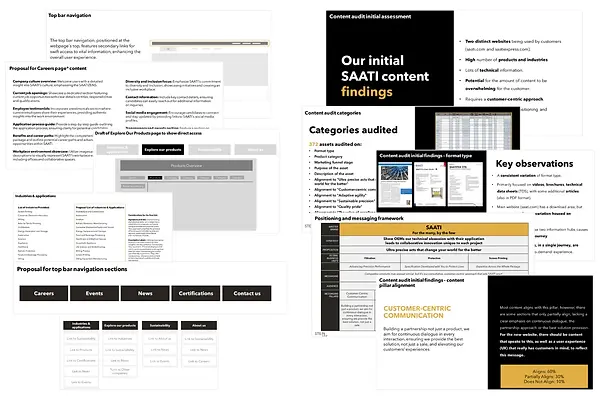
These visuals show key artefacts from the project, including discovery presentations, UX analysis, wireframes, modular components, and design system elements. Together, they illustrate how complexity was translated into a clear, structured, and scalable B2B experience.
.webp)


Outcomes
A clearer, more effective B2B digital experience
The redesign delivered a clearer information architecture aligned with the buyer journey, making complex products easier to understand and navigate. Improved structure, testing, and reusable components reduced friction, strengthened usability and accessibility, and created a more effective platform to support lead generation and long-term growth.